
Scrupulosity
Religious or Moral OCD
Scrupulosity often looks like a strong desire to do what’s right—but internally, it can feel overwhelming, filled with doubt, guilt, and constant fear of doing something wrong. Many people feel stuck in cycles of overthinking, anxiety, and mental checking, even while trying to live according to their values.
Therapy isn’t about changing your beliefs—it’s about helping you feel more at peace in how you live them.
We work with many individuals navigating scrupulosity within religious communities, including those in Utah and surrounding areas.

What Scrupulosity Really Is
Scrupulosity is a form of OCD that centers on moral, ethical, or religious concerns.
It involves intrusive thoughts about doing something wrong, followed by compulsive behaviors meant to reduce fear or guilt. Over time, these patterns become excessive, distressing, and difficult to step away from.
While it often attaches to faith or values, scrupulosity is caused by OCD—not by a person’s beliefs.
How Scrupulosity Can Show Up
Obsessions (Intrusive Fears):
-
-
Fear of committing a sin or moral violation
-
Worry about disappointing God or breaking religious rules
-
Intrusive blasphemous or immoral thoughts
-
Fear of lying, cheating, stealing, or harming others
-
Excessive doubt about one’s intentions
-
Compulsions (Attempts to Reduce Anxiety or Fear):
-
-
Repeated prayer or ritualized confession
-
Seeking reassurance from clergy, friends, or family
-
Overanalyzing thoughts or actions
-
Avoiding situations that might involve moral risk
-
Excessive checking to make sure nothing wrong was said or done
-

examples of scrupulosity
religious scrupulosity
-
Repeating prayers until they feel “perfect”
-
Avoiding religious activities due to fear of doing them incorrectly
-
Frequently asking clergy whether a sin was committed
moral scrupulosity
-
Replaying conversations to make sure nothing dishonest was said
-
Feeling intense guilt about minor, accidental actions
-
Giving away money or possessions to “make up” for perceived wrongs
common internal thoughts
-
“What if I offended God without realizing it?”
-
“What if that thought means I’m a bad person?”
-
“What if I accidentally lied?”
-
“What if I caused harm and don’t remember?”
When Scrupulosity Feels Bigger
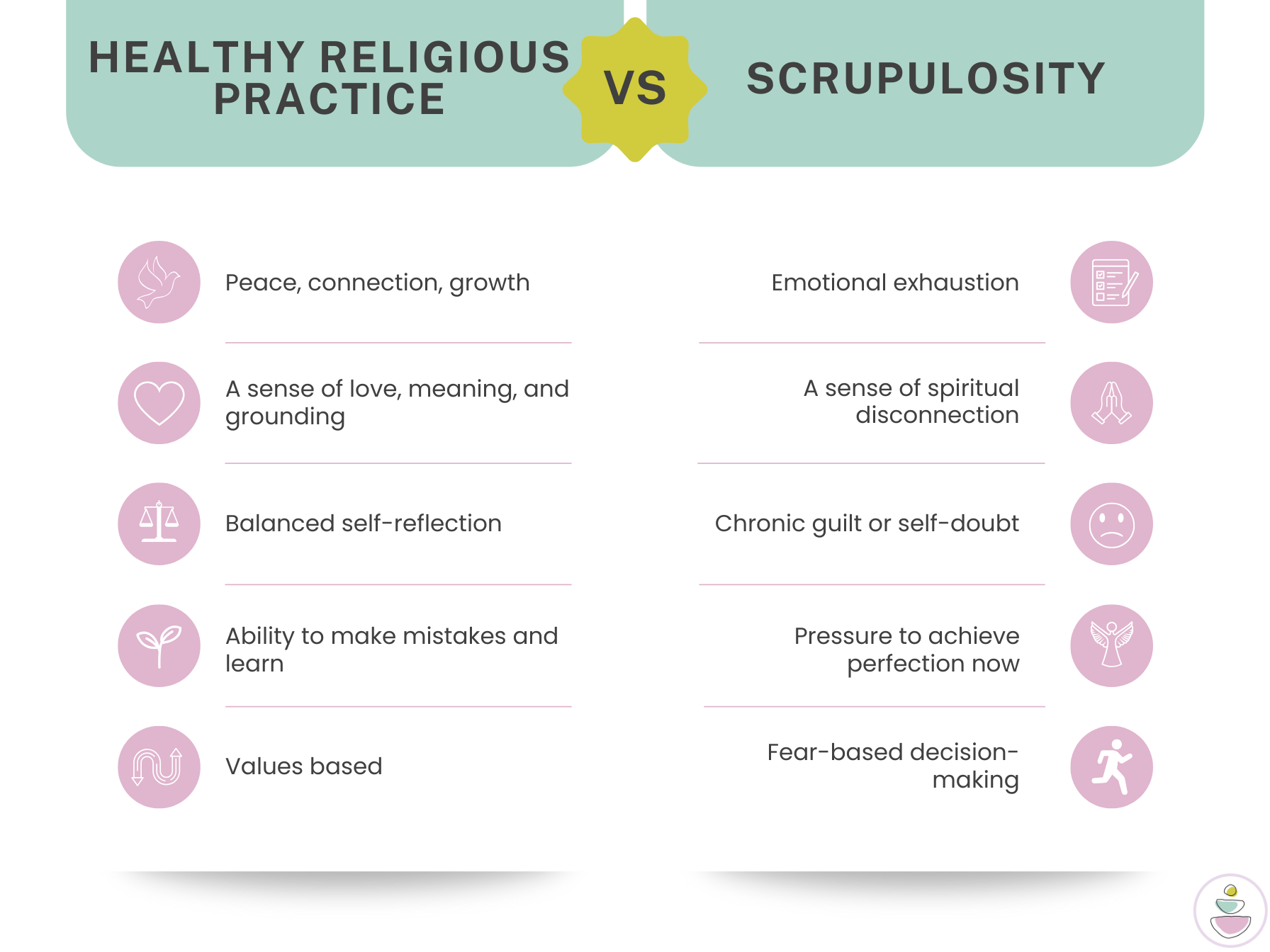
For many, scrupulosity goes beyond everyday concern and becomes rigid and overwhelming.
Instead of feeling grounded in your values, you may feel:
-
- Driven by fear rather than intention
- Stuck in cycles of doubt and overanalysis
- Disconnected from peace or meaning in your faith
- Mentally exhausted from constant checking
What once felt meaningful can begin to feel heavy and distressing.
The emotional cost
Scrupulosity often creates a sense of control in the moment—but over time, it can lead to:


Feeling “never good enough”

Constant fear of doing something wrong

Difficulty feeling peace or trust in yourself
How Therapy Helps
In therapy, we focus on helping you:
-
- Respond differently to intrusive thoughts
- Reduce compulsive behaviors and reassurance-seeking
- Build tolerance for uncertainty
- Separate OCD from your values and beliefs
- Develop a more compassionate relationship with yourself
As scrupulosity decreases, many people find they can engage in their faith and values with more flexibility and peace.

Frequently asked questions
How do I know if I have scrupulosity?
Scrupulosity often involves persistent religious or moral doubts that feel difficult to resolve. You may seek certainty about whether you sinned, acted with the right intention, or made the right choice. While wanting to do what’s right and live in alignment with your morals or religious beliefs is completely understandable, scrupulosity can make beliefs or practices that would otherwise bring peace feel distressing or hopeless. A therapist can help you understand the difference between typical religious or moral concerns and patterns that may be related to scrupulosity or OCD.
What are the most common symptoms of scrupulosity?
Common signs include intrusive religious fears, intense guilt, and repeated attempts to feel certain. You may also notice that reassurance only helps for a short time before the doubt returns.
Are intrusive religious or blasphemous thoughts a sign of scrupulosity?
They may be. Scrupulosity often attaches fear to thoughts that conflict with your beliefs or values. Having an unwanted thought doesn’t reflect your faith, intentions, or character.
Is repeated prayer or confession a compulsion in scrupulosity?
Prayer or confession may become compulsive when you repeat it mainly to reduce anxiety or gain certainty. The behavior itself isn’t the problem. Your reason for doing it and the pattern around it help determine whether scrupulosity plays a role.
Why does scrupulosity cause so much guilt and doubt?
Scrupulosity often makes uncertainty feel morally dangerous. Even after receiving reassurance, you may question whether you acted correctly or meant the right thing. That cycle keeps guilt and doubt active.
What causes scrupulosity?
Scrupulosity develops when OCD-related fear attaches itself to religious or moral concerns. Faith itself doesn’t cause scrupulosity. The condition often targets beliefs and values that already hold deep importance for you.
What is the best therapy for scrupulosity?
Exposure and Response Prevention, often called ERP, is a widely used treatment for scrupulosity. Therapy helps you face uncertainty while reducing the compulsive responses that keep the cycle going. Acceptance and Commitment Therapy (ACT) can be an additional support to ERP, helping you live in alignment with your values even when anxiety or uncertainty is present.
How does ERP therapy work for scrupulosity?
ERP helps you gradually face religious or moral uncertainty without completing the usual compulsion. Your therapist works with you at a manageable pace while respecting your beliefs and values.
How do I stop reassurance-seeking with scrupulosity?
Treatment helps you notice the urge to seek reassurance and practice responding differently. Over time, you’ll learn to tolerate uncertainty without needing someone else to confirm that everything is OK.
Will scrupulosity treatment ask me to change my religious beliefs?
No. Scrupulosity treatment focuses on the OCD pattern rather than your faith. Your therapist respects your religious beliefs and helps you separate meaningful religious practice from fear-driven compulsions.
A Different Way Forward
You don’t have to live in constant doubt or fear.
Therapy helps you hold onto what matters—your values, your faith, your integrity—while letting go of the patterns that keep you stuck.
start feeling more
flexible, confident, and at ease.
Get In Touch

offices
1896 N 1120 W, Provo, UT 84604
2975 W Executive Pkwy, Suite 272, Lehi, UT 84043